
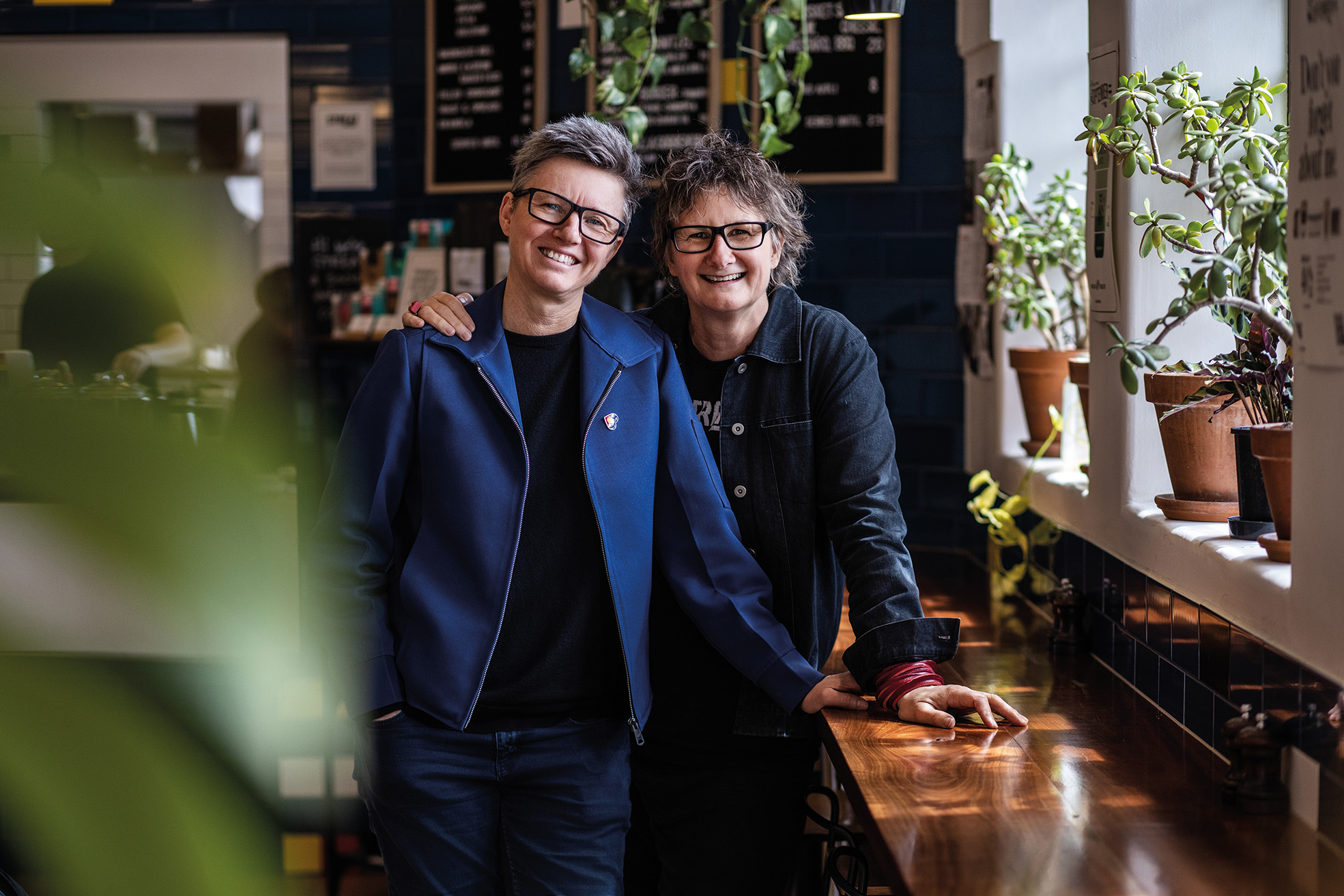
STREAT Co-Founders Rebecca Scott OAM and Dr Kate Barrelle at the STREAT Parkville Cafe.
PHOTO: Guy Lavoipierre
STREAT’s Co-Founder and Chief Impact Officer, Dr Kate Barrelle, tells a powerful story of watching a young man deliver a coffee to a customer in STREAT’s Parkville café.
The young man had made the caffe latte, and now brought it to the customer who took a sip. “The customer said thanks, that’s good coffee, or simple words to that effect and I’m not kidding, you could see him grow two or three centimetres taller,” Kate recalled.
Sometimes in that moment, Kate said, a trainee will be unable to talk, or will develop ridiculous swagger, or just smile and shake their head.
Why? Because this “Nice coffee” is often the first genuine compliment in their lives; their first ever encouragement for doing something well. Think about that for a moment: arriving at 18 or 20 years of age, having never received a single piece of positive reinforcement.
The young people that STREAT seeks to help have had plenty of years of being told all the bad stuff.
STREAT’s Thyme Out program offers six weeks of real work in a real café as well as tailored support. It involves a suitable young person coming out on supervised day release where they are making and serving coffees to customers.
Newsboy’s support for this program provides young people in the criminal justice system an alternative path; one that develops strengths instead of accentuating the behaviours, habits and ecosystem that leads back to trouble.
Given the recidivism rate of young people in Victoria returning to prison is estimated at between 50 and 80 per cent, the economic and social benefits of lowering that figure are compelling.
YOUNG AND VULNERABLE
The profile of teenagers entering the youth justice system follows a depressingly consistent formula and, without intervention, they have a high chance of social failure and a life in and out of prison.
Kate says compound disadvantage has often led to the young person finding themselves behind bars in a youth correctional facility. No stable adult or role model in their life? Psychological or physical trauma because of the people who are in their life? Substance abuse as self-medication? Cognitive issues? Cultural or First Nation complexities? You can tick them off.
It’s a ghastly blueprint that reveals which young people are most likely to slip into criminal behaviour, because of any combination of the six or seven disadvantages.
The technical term is “intersectionality” but Kate says you only need to look at the hard and clear data from Victoria’s Parole Board that shows two-thirds of the young people fronting the Board are survivors of trauma or violence, and 50 per cent have been placed under child protection orders, which Kate says demand an alarming threshold to even be granted, because of an under-resourced system.
THE COST OF ACTION, OR INACTION
Backed by Newsboys, STREAT is working to break the cycle. The average 16-year-old, drifting into the criminal justice system as described above, costs the government a disturbing $7775 per day (more than $2.8 million a year) in detention costs alone (according to the Productivity Commission’s Report on Government Services 2025) and that’s before you get to wider potential costs, such as police, legal, health, psychological and unemployment services.
Without intervention, research shows that a wayward teenager will cost governments millions of dollars in care and management throughout their lifetime.
Or, there’s the STREAT plan … to step in and offer a more productive, hopeful future path, teaching them skills before they’re even released from prison, through the Thyme Out program – which includes ongoing funding by Newsboys.
Then to follow up, upon release, with stable transitional housing, counselling, reducing drug use, genuine vocational training to make them workplace ready – in hospitality or other fields – and then transitional support into actual work.
Surrounding them with supportive friends, mentors and workmates means they are less likely to seek out the friendship group that saw them get into trouble before, and their confidence can build so that they can attempt a more productive, satisfying life – even becoming a contributing taxpayer.
The estimated annual cost of STREAT’s work for that 16-year-old in that moment of transitional danger is about $45,000 (as against much more than that in government spending for damage control; not just now but in the years to come).
Hence, the gratitude and need for Newsboys’ assistance.
NEWSBOYS’ SUPPORT
Kate said: “We never take Newsboys’ funding for granted. One thing we have learned is that to support young people, there is something that has a more critical effect than clever techniques or strategies. It’s trust. Our support for them needs to be predictable and consistent and, in a similar vein, Newsboys provides that for us. It’s not a one-off sugar hit of funding, or stop-start support that we need to tap-dance for. Newsboys’ support is reliable and it’s a trusted partnership where we know Newsboys understands the importance of what we are looking to achieve, and how vital it is to these young lives, and we know there is an enormous alignment, that means we don’t have to go hustling for money. We can do the actual work.
“Even Newsboys’ origins, in providing education and life skills to the newsboys, aligns with what Thyme Out is about. Newsboys’ support makes such a huge difference for us,” she said.
With continuing support, STREAT is confident the long-term results for young people exiting the criminal justice system can be even stronger. The organisation has embraced working with other not for profits and Work Integration Social Enterprises (WISE) where possible to ensure there are layers of wrap-around support for them, across the state. For example, one graduate of Thyme Out – let’s call him Stephen – headed back to his major regional town, where he had previously only found trouble. STREAT reached out to another WISE, an allied café, where the owner employed him, and Stephen not only utilised his STREAT-learned skills, he began teaching other local youths hospitality skills.
“Nobody is talking about his criminal history anymore; they are talking about the way he makes his lattes,” Kate said. “He’s a respected local young man.”
Nick Place